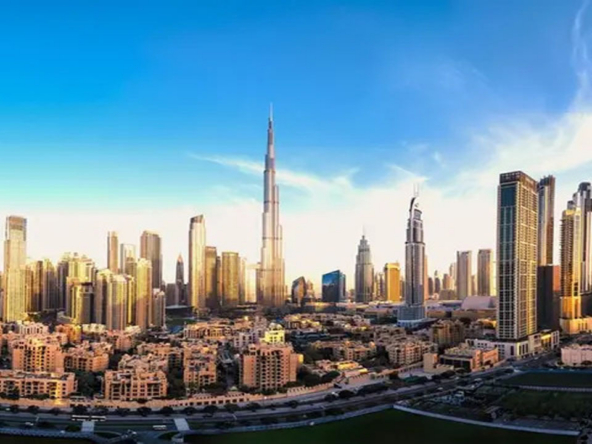

RIYADH: The UAE’s residential real estate sector is projected to experience a gradual slowdown in home sales and mild price softening over the next 12 to 18 months, as a wave of new project completions increases supply, according to a recent report by Moody’s.
Despite the anticipated easing, the ratings agency emphasized that property developers remain financially well-positioned, supported by strong revenue backlogs and solid balance sheets. At the same time, regulatory measures have reduced banks’ exposure to construction and real estate lending, helping preserve healthy liquidity and capital buffers across the financial system.
Strong Performance in 2025
The outlook follows robust activity across the UAE property market during the first three quarters of 2025.
According to data cited by Kuwait Financial Centre (Markaz):
- In Dubai, real estate transaction values climbed 28.3% year-on-year to AED 554.1 billion ($150.88 billion).
- Abu Dhabi recorded total sales of AED 58 billion, marking a 75.8% annual increase.
- Transaction volumes in Abu Dhabi rose 42.3% to 15,800 deals.
However, after five years of exceptional growth — particularly in Dubai — Moody’s expects a modest pullback in developer sales and some price moderation as supply expands.
Between 2026 and 2028, approximately 180,000 new residential units are scheduled for completion in Dubai — a substantial increase compared to previous years — which could temper demand and slow price growth.
Nonetheless, underlying fundamentals remain supportive, driven by continued population growth and an influx of high-net-worth individuals. Moody’s expects rated developers to maintain resilient credit quality, supported by front-loaded payment plans and strong liquidity positions.
Industry Leaders See Healthy Market Adjustment
Munir Al-Daraawi, Founder and CEO of Orla Properties, described the anticipated moderation as a natural phase in the evolution of a maturing global market like Dubai.
He noted that the delivery of 180,000 new units reflects long-term confidence in the UAE’s attractiveness to global investors and residents rather than a sign of oversupply. He added that Dubai’s 2040 Urban Master Plan and sustained inflows of international talent continue to underpin the sector’s resilience.
Similarly, Riad Gohar, Co-Founder and CEO of BlackOak Real Estate, argued that the current cycle differs significantly from previous downturns.
He highlighted that around 83% of residential transactions in Dubai during 2024 and 2025 were completed without mortgages, indicating a predominantly equity-driven market rather than one fueled by debt. In such cycles, corrections tend to be shallow and limited to specific segments rather than systemic.
Gohar also pointed to strong macroeconomic fundamentals, including non-oil GDP growth, regulatory reforms, capital inflows, and sustained migration, as key drivers of demand. He emphasized that any pressure from rising completions is more likely to impact secondary or non-prime locations, while established prime areas historically demonstrate resilience.
Banking Sector Remains Shielded
Bank exposure to real estate has declined significantly in recent years, falling to approximately 12% of total loans from 19% in 2021. Non-performing loans remain low at 2.9%, limiting financial contagion risks.
Stricter escrow regulations and tighter oversight mechanisms have further reduced systemic vulnerability, reinforcing market stability even in a more competitive environment.
Strategic Shifts and Diversification
While most rated developers are expected to generate significant excess cash over the next two to three years, Moody’s noted that investment opportunities within Dubai may become more limited, prompting a strategic shift in capital deployment and corporate governance practices.
Some developers are expanding into new property segments. For example:
- Binghatti has launched its first master-planned villa community, moving beyond its traditional focus on high-rise developments as villa demand continues to outperform apartments.
Others are pursuing geographic diversification:
- Hussain Sajwani, owner of Damac, has announced major investments in data centers across the US and Europe.
- Emaar continues expanding in Egypt and India while evaluating potential entry into China and the US.
- Aldar has initiated projects in the UK and Egypt.
- Arada has begun developments in Australia and the UK.
- Sobha is expanding into the US market.
Outlook: Moderation, Not Correction
Overall, Moody’s suggests the UAE residential market is entering a phase of normalization rather than decline. While sales activity and price growth may soften modestly, strong economic fundamentals, disciplined regulation, and cash-driven demand are expected to maintain market resilience.