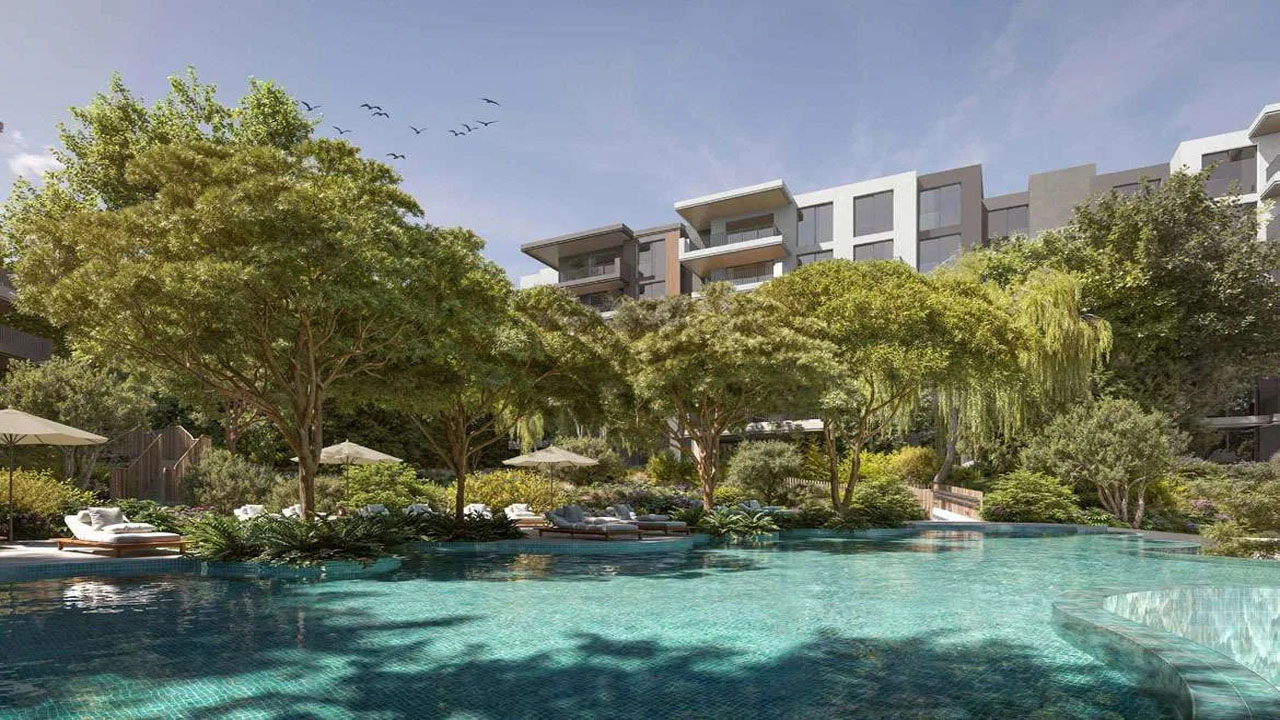
Across emerging villa neighborhoods in Dubai and Sharjah, greenery is no longer treated as a secondary feature — it is becoming the central selling proposition. New masterplans increasingly highlight tree-lined streets, shaded walkways, and continuous landscape corridors that weave through entire communities. Instead of homes positioned on open plots with minimal planting, marketing visuals now showcase residences immersed within dense, layered greenery.
This reflects a broader shift in how residential projects across the UAE are conceptualized and promoted. While landscaping has always been included in developments, it traditionally took the form of parks or decorative roadside planting. Today, vegetation is more deeply embedded into the planning framework itself, influencing street design, open-space allocation, and everyday outdoor living.
In a region defined by high temperatures, shade and tree cover extend the usability of public spaces and improve year-round comfort. For many buyers — especially families — this enhances perceived quality of life. As more developers adopt this model, the market is beginning to assess whether nature-integrated planning, often referred to as “forest living,” can command stronger demand and price resilience.
Green Communities Attract Premium Buyers
Developers report that interest in nature-rich residential environments has grown alongside rising awareness of wellness, air quality, and overall lifestyle quality.
Ravi Menon, Chairman of Sobha Group, notes that biophilic design is increasingly viewed as a core feature of premium housing rather than an optional enhancement.
He explains that buyers today are not only willing to pay a premium for nature-integrated communities but often expect them. Globally, heightened awareness of mental well-being, environmental quality, and the emotional benefits of proximity to nature has reshaped residential priorities. In fast-growing markets like the UAE, nature-led living is evolving from a design trend into a long-term investment preference.
At Sobha Realty, this shift is visible in buyer behavior within projects such as Sobha Elwood — a 10-million-square-foot development featuring approximately 10,000 trees. Nearly 40 percent of the masterplan is dedicated to open spaces, landscaped streets, and parks inspired by global forest ecosystems.
According to Menon, features such as microclimate cooling, water elements, and shaded trails transform these neighborhoods into immersive environments rather than conventional housing clusters. He adds that homes in nature-dense communities often achieve stronger absorption rates, improved retention, and sustained long-term demand.
Biophilic Design Redefines Residential Value
Beyond aesthetics, dense planting influences how residents interact with their surroundings. Shaded pedestrian routes encourage outdoor activity during warmer months, while vegetation moderates localized temperatures and creates quieter, calmer spaces.
Menon believes residential value is increasingly linked to environmental experience rather than architecture alone. Globally, there is a noticeable shift from purely structural value to experiential value — and the UAE has been quick to adopt this approach.
By integrating greenery into the daily rhythm of community life, developers aim to promote healthier lifestyles, increased social interaction, and enhanced emotional well-being.
Major UAE Projects Embrace Forest-Led Planning
Several large-scale developments are already bringing the forest-living concept into reality.
In Dubai, Majid Al Futtaim has introduced Ghaf Woods, positioned as the city’s first forest-integrated neighborhood. Built around more than 35,000 native ghaf trees, the project is designed to reduce local temperatures by up to 5°C while improving air quality — placing vegetation at the core of urban planning rather than as a decorative layer.
Within this masterplan, Maravelle Residences — a limited collection of 96 homes across four boutique buildings — represents a low-density wellness-focused enclave embedded within the forest setting. Ahmed El Shamy, CEO of Majid Al Futtaim Development, describes the project as a redefinition of real estate value, emphasizing health benefits, sustainability, and people-centric design.
Meanwhile, in Sharjah, Arada has adopted a similar approach with Masaar. Organized around a central forest spine linking neighborhoods through shaded pedestrian networks, the development’s latest phase, Masaar 3, expands across 21 million square feet and incorporates over 100,000 trees alongside 4,000 villas and townhouses.
According to Ahmed Alkhoshaibi, Group CEO of Arada, the continued expansion reflects sustained buyer demand for sustainable, family-oriented communities that also offer long-term capital appreciation.
Projects such as Sharjah Sustainable City, which dedicates more than 30 percent of its land to green areas, further demonstrate the region’s growing emphasis on environmentally integrated urban design.
From Landscaping to Environmental Infrastructure
As climate challenges intensify, developers are increasingly treating vegetation as functional infrastructure rather than ornamental design. Layered tree canopies help reduce radiant heat, improve airflow, and enhance biodiversity. Planted corridors shape shading patterns and support long-term environmental resilience.
Menon describes this evolution as the next phase of forest-style development in the UAE — one guided by climate-responsive, data-driven planning rather than simple landscaping. He links the trend to the country’s broader greening vision, rooted in Sheikh Zayed’s early commitment to transforming desert landscapes.
Today’s projects build upon that legacy through microclimate modeling, adaptive planting strategies, and recreational zones designed around natural ecosystems.
Ultimately, these systems reshape how residential value is defined. Nature-integrated communities are no longer marketed purely for aesthetics — they are positioned as resilient, wellness-oriented environments offering sustainable livability and long-term investment appeal.